Appearance
一、全量diff
全量diff主要是针对两个子节点都是数组的情况,需要对它所有的子元素进行全量更新,这种情况更新非常消耗性能,在vue中会尝试尽可能的复用dom,来进行更新。
双端diff
头部对比
头部对比的场景,假设子节点是通过v-for渲染出来的,最开始数组为[a, b],然后push了一个c进去:
c1 = [a, b]c2 = [a, b, c]此时只需要从头开始进行对比就可以,c1的第一个为a,c2的第一个也是a,他们的key都是可以对应上的,所以依次对比a和b,到c之后,发现c1里面没有c,则直接挂载新的子节点就可以。如图: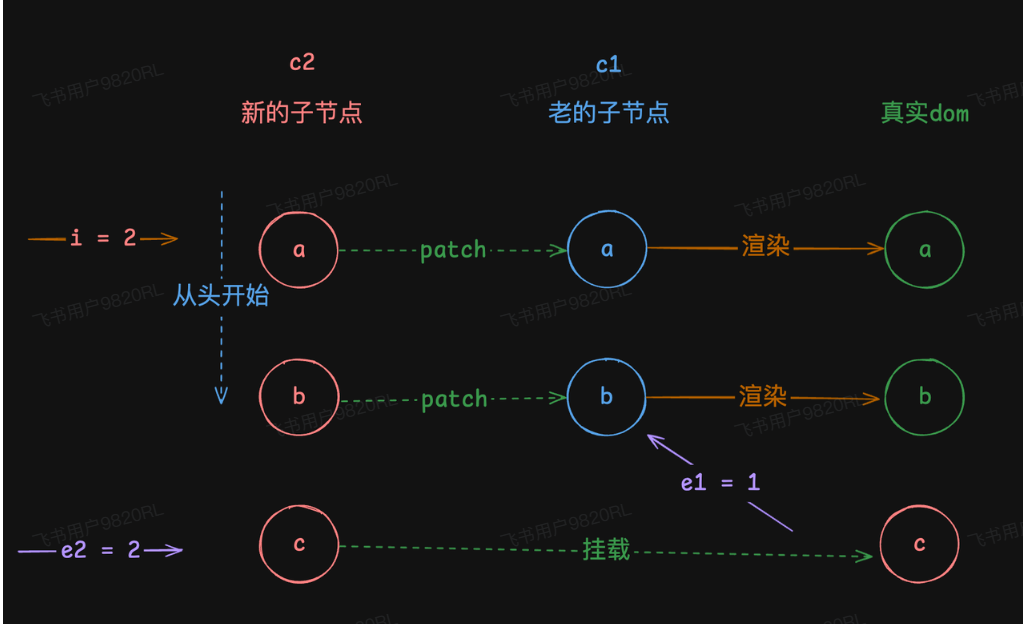 实现代码:
实现代码:
ts
const patchChildren = (n1, n2) => {
    const el = n2.el
    /**
     * 1. 新节点n2的子节点是文本
     *  1.1 老的是数组
     *  1.2 老的也是文本
     * 2. 新节点子节点是数组 或者null
     *  2.1 老的也是数组
     *  2.2 老的是文本
     *  2.3 老的可能是null
     */
    const prevShapeFlag = n1.shapeFlag
    const shapeFlag = n2.shapeFlag
    // 新的是文本
    if (shapeFlag & ShapeFlags.TEXT_CHILDREN) {
        // 老的是数组,卸载掉老的
        if (prevShapeFlag & ShapeFlags.ARRAY_CHILDREN) {
            unmountChildren(n1.children)
        }
        // 如果n1 和n2的children不一样, 进行设置文本
        if (n1.children !== n2.children) {
            hostSetElementText(el, n2.children)
        }
    } else {
        // 老的有可能是数组或者null 或者文本
        // 新的是数组,或者null, 老的也有可能是null

        // 老的是文本
        if (prevShapeFlag & ShapeFlags.TEXT_CHILDREN) {
            // 把老的子元素节点干掉
            hostSetElementText(el, '')
            if (shapeFlag & ShapeFlags.ARRAY_CHILDREN) {
                // 挂载新的节点
                mountChildren(n2.children, el)
            }
        } else {
            // 老的数组或者null
            // 新的是数组或者null
            if (prevShapeFlag & ShapeFlags.ARRAY_CHILDREN) {
                // 老的是数组
                if (shapeFlag & ShapeFlags.ARRAY_CHILDREN) {
                    // 新的也是数组, 全量diff
                    patchKeyedChildren(n1.children, n2.children, el)
                } else {
                    // 新的不是数组,卸载老的数组
                    unmountChildren(n1.children)
                }
            } else {
                // 老的是null
                if (shapeFlag & ShapeFlags.ARRAY_CHILDREN) {
                    // 新的是数组
                    mountChildren(n2.children, el)
                }
            }
        }
    }
}
const patchKeyedChildren = (c1, c2, container) => {
    // 开始对比下标
    let i = 0

    // 老的子节点的最后一个元素下标
    let e1 = c1.length - 1

    // 新的子节点最后一个元素下标
    let e2 = c2.length - 1

    /**
     * 头部对比
     * c1 = [a,b]
     * c2 = [a,b,c]
     *
     * 开始时: i=0 ,e1=1,e2=2
     * 结束时: i=2,e1=1,e2=2
     */
    while(i <= e1 && i <= e2) {
        const n1 = c1[i]
        const n2 = c2[i]

        if(isSameVNodeType(n1, n2)) {
            // 如果n1和n2是同一个类型的子节点,那就可以更新,更新完了对比下一个
            patch(n1, n2, container)
        } else {
            break
        }
        i++
    }
}尾部对比
除了头部对比,实际中,不一定只是向尾部添加元素,还有可能往头部添加,比如unshift,往头部添加一个子节点c:
c1 = [a, b]c2 = [c, a, b]此时明显头部对比就对比不上了,因为c1的第一项是a,c2的第一项是c,在头部对比的代码中第一次就会被break,但是头部虽然对比不上,尾部是可以对比的,比如c1的最后一项是b,c2的最后一项也是b,那么就可以倒着比:如图: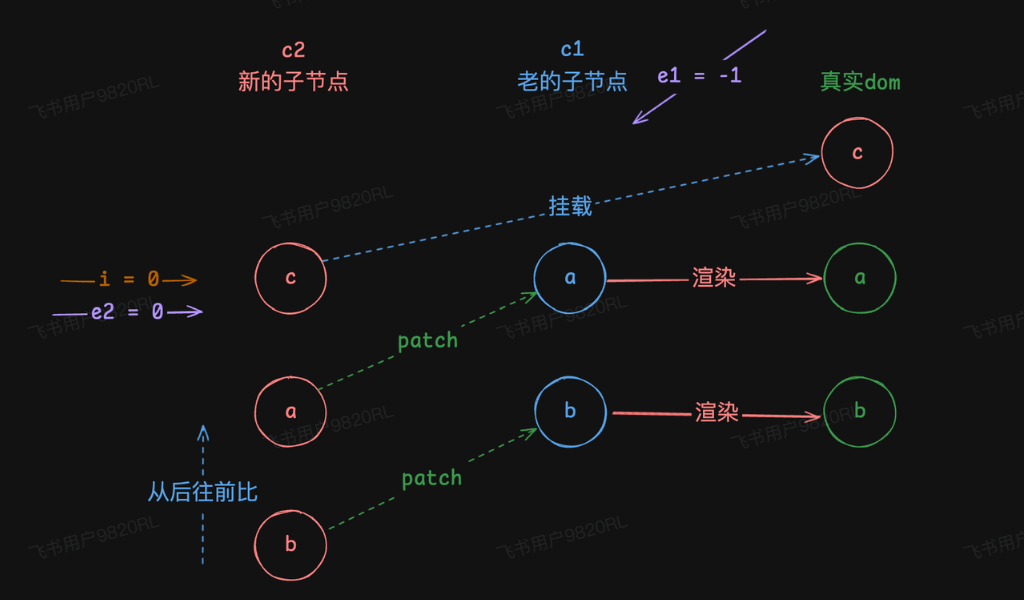 实现代码:
实现代码:
ts
    // 开始对比的下标
    let i = 0

    // 老的子节点的最后一个元素的下标
    let e1 = c1.length - 1

    // 新的子节点的最后一个元素的下标
    let e2 = c2.length - 1

    /* 省略头部对比的代码 */
    /**
     * * 1.2 尾部对比
     *
     * c1 => [a, b]
     * c2 => [c, d, a, b]
     * 开始时:i = 0, e1 = 1, e2 = 3
     * 结束时:i = 0,e1 = -1, e2 = 1
     */
    while(i <= e1 && i <= e2) {
        const n1 = c1[e1]
        const n2 = c2[e2]
        if(isSameVNodeType(n1, n2)) {
            patch(n1, n2, container)
        } else {
            break
        }
        // 更新尾指针
        e1--
        e2--
}结论
当双端diff完成后,可以得出一下结论:
- 当
i > e1的时候,表示新的子节点多,老的子节点少,所以需要插入新的子节点。插入范围i - e2 - 当
e > e2的时候,表示老的多,新的少,需要将老的子节点中多余的卸载掉。
ts
if (i > e1) {
    /**
     * 根据双端对比,得出结论:
     * i > e1 表示老的少,新的多,要挂载新的,挂载的范围是 i - e2
     */
    const nextPos = e2 + 1
    // 由于挂载不一定是追加到父元素的最后面,所以此处需要获取到 anchor,插入到某个元素之前
    const anchor = nextPos < c2.length ? c2[nextPos].el : null
    console.log(anchor)
    while (i <= e2) {
        patch(null, c2[i], container, anchor)
        i++
    }
} else if (i > e2) {
    /**
     * 根据双端对比,得出结果:
     * i > e2 的情况下,表示老的多,新的少,要把老的里面多余的卸载掉,卸载的范围是 i - e1
     */
    while (i <= e1) {
        unmount(c1[i])
        i++
    }
}获取到了anchor,是因为每次更新不一定是插入到元素的最后,比如:
c1 = [a, b]c2 = [c, a, b]这种情况下,c肯定是要插入到a之前,所以需要想办法拿到a,对比结束后,e1应该等于c的索引,那么a的索引应该是e2 + 1。通过索引拿到anchor,传递给patch,从patch到mountElement之间所有调用将传递anchor。
二、乱序diff
如果数据顺序是乱的。
ts
// c1 => [a, b, c, d, e]
const vnode1 = h('div', [
    h('p', { key: 'a', style: { color: 'blue' } }, 'a'),
    h('p', { key: 'b', style: { color: 'blue' } }, 'b'),
    h('p', { key: 'c', style: { color: 'blue' } }, 'c'),
    h('p', { key: 'd', style: { color: 'blue' } }, 'd'),
    h('p', { key: 'e', style: { color: 'blue' } }, 'e')
])

// c2 => [a, c, d, b, e]
const vnode2 = h('div', [
    h('p', { key: 'a', style: { color: 'red' } }, 'a'),
    h('p', { key: 'c', style: { color: 'red' } }, 'c'),
    h('p', { key: 'd', style: { color: 'red' } }, 'd'),
    h('p', { key: 'b', style: { color: 'red' } }, 'b'),
    h('p', { key: 'e', style: { color: 'red' } }, 'e')
])

render(vnode1, app)

setTimeout(() => {
    render(vnode2, app)
}, 1000)在这组数据红,可以看到,数据从[a, b, c, d, e]变成[a, c, d, b, e],这样的话顺序就发生了变化,但是这些key还是在的,所以就需要去找对应的key,进行patch。 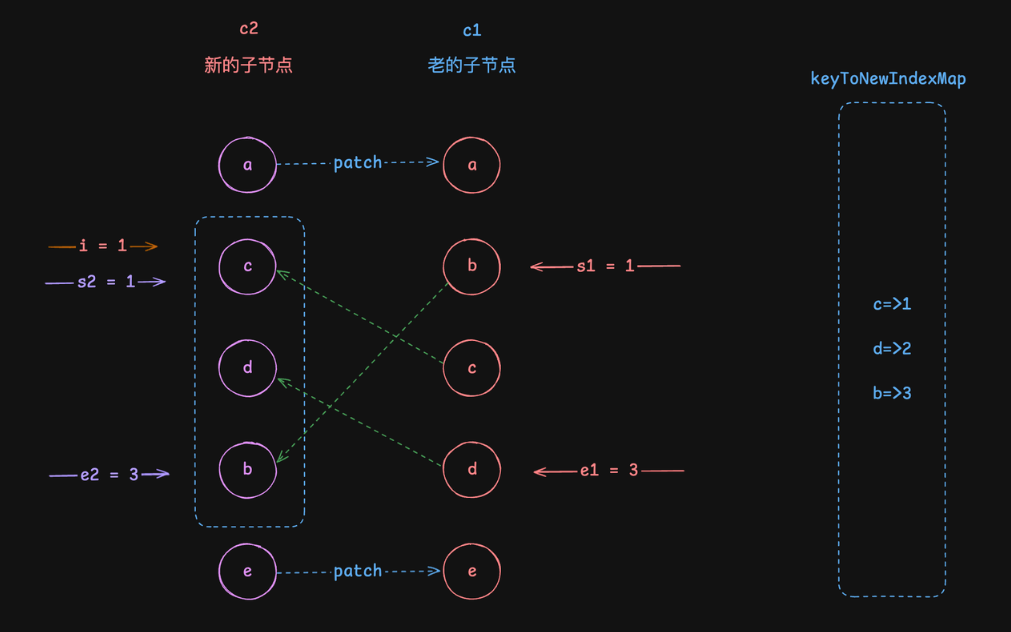 当双端对比结束后,此时
i = 1,e1 = 3, e2 = 3,此时i既不大于e1,也不小于e2,中间还有三个没有对比完,但是这些key还是在的,所以需要到c1中找到对应的key的虚拟节点,进行patch:
ts
// 老的子节点开始查找的位置 s1 - e1let s1 = i
// 新的子节点开始查找的位置 s2 - e2let s2 = i

/**
 * 做一份新的子节点的key和index之间的映射关系
 * map = {
 *   c:1,
 *   d:2, *   b:3 * }
 */
const keyToNewIndexMap = new Map()
/**
 * 遍历新的 s2 - e2 之间,这些是还没更新的,做一份 key => index map
 */
for(let j = s2; j <= e2; j++) {
    const n2 = c2[j]
    keyToNewIndexMap.set(n2.key, j)
}
/**
 * 遍历老的子节点
 */
for(let j = s1; j <= e1; j++) {
    const n1 = c1[j]
    const newIndex = keyToNewIndexMap.get(n1.key)
    if(newIndex != null) {
        patch(n1, c2[newIndex], container)
    } else {
        unmount(n1)
    }
}在这段代码红,声明了一个keyToNewIndexMap用来保存c2中的key对应的index,这样后续就可以快速通过这个key找到对应的虚拟节点进行patch。但是目前顺序还是不对,需要遍历新的子节点,将每个子节点插入到正确的位置:
ts
/**
 * 1. 遍历新的子元素,调整顺序,倒序插入
 * 2. 新的有,老的没有的,我们需要重新挂载
 */
for (let j = e2; j >= s2; j--) {
    /**
     * 倒序插入
     */
    const n2 = c2[j]
    // 拿到它的下一个子元素
    const anchor = c2[j + 1]?.el || null
    if (n2.el) {
        // 依次进行倒序插入,保证顺序的一致性
        hostInsert(n2.el, container, anchor)
    } else {
        // 新的有,老的没有,重新挂载
        patch(null, n2, container, anchor)
    }
}至此,真实 dom 更新完毕,顺序也 ok!
完整代码:
ts
export function createRenderer(options) {
    // 虚拟节点渲染到页面的功能

    const {
        createElement: hostCreateElement,
        insert: hostInsert,
        remove: hostRemove,
        setElementText: hostSetElementText,
        createText: hostCreateText,
        setText: hostSetText,
        parentNode: hostParentNode,
        nextSibling: hostNextSibling,
        patchProp: hostPatchProp,
    } = options

    // 卸载子元素
    const unmountChildren = children => {
        for (let i = 0; i < children.length; i++) {
            const child = children[i]
            // 递归挂载子节点
            unmount(child)
        }
    }
    // 卸载
    const unmount = vnode => {
        const { type, shapeFlag, children } = vnode

        if (shapeFlag & ShapeFlags.ARRAY_CHILDREN) {
            // 子节点是数组
            unmountChildren(children)
        }
        // 移除dom元素
        hostRemove(vnode.el)
    }

    // 挂载子元素
    const mountChildren = (children, el) => {
        for (let i = 0; i < children.length; i++) {
            const child = children[i]
            // 递归挂载子节点
            patch(null, child, el)
        }
    }

    // 挂载
    const mountElement = (vnode, container, anchor) => {
        /**
         * 1. 创建一个dom节点
         * 2. 设置他的props
         * 3. 挂载子节点
         */
        const { type, props, children, shapeFlag } = vnode

        // 创建dom节点  type= div, p span
        const el = hostCreateElement(type)
        // 更新的时候复用,卸载的时候用el,删除这个el,完成卸载
        vnode.el = el

        // 设置props
        if (props) {
            for (const key in props) {
                hostPatchProp(el, key, null, props[key])
            }
        }

        // 挂载子节点
        if (shapeFlag & ShapeFlags.TEXT_CHILDREN) {
            // 子节点是文本
            hostSetElementText(el, children)
        } else {
            // 子节点是数组
            if (shapeFlag & ShapeFlags.ARRAY_CHILDREN) {
                mountChildren(children, el)
            }
        }
        // 把el插入到container中
        hostInsert(el, container, anchor)
    }

    // 更新props
    const patchProps = (el, oldProps, newProps) => {
        /**
         * 1. 把老的删除掉
         * 2. 把新的设置上
         */
        if (oldProps) {
            // 删除老的
            for (const key in oldProps) {
                hostPatchProp(el, key, oldProps[key], null)
            }
        }
        if (newProps) {
            for (const key in newProps) {
                hostPatchProp(el, key, oldProps?.[key], newProps[key])
            }
        }
    }

    const patchChildren = (n1, n2) => {
        const el = n2.el
        /**
         * 1. 新节点n2的子节点是文本
         *  1.1 老的是数组
         *  1.2 老的也是文本
         * 2. 新节点子节点是数组 或者null
         *  2.1 老的也是数组
         *  2.2 老的是文本
         *  2.3 老的可能是null
         */
        const prevShapeFlag = n1.shapeFlag
        const shapeFlag = n2.shapeFlag
        // 新的是文本
        if (shapeFlag & ShapeFlags.TEXT_CHILDREN) {
            // 老的是数组,卸载掉老的
            if (prevShapeFlag & ShapeFlags.ARRAY_CHILDREN) {
                unmountChildren(n1.children)
            }
            // 如果n1 和n2的children不一样, 进行设置文本
            if (n1.children !== n2.children) {
                hostSetElementText(el, n2.children)
            }
        } else {
            // 老的有可能是数组或者null 或者文本
            // 新的是数组,或者null, 老的也有可能是null

            // 老的是文本
            if (prevShapeFlag & ShapeFlags.TEXT_CHILDREN) {
                // 把老的子元素节点干掉
                hostSetElementText(el, '')
                if (shapeFlag & ShapeFlags.ARRAY_CHILDREN) {
                    // 挂载新的节点
                    mountChildren(n2.children, el)
                }
            } else {
                // 老的数组或者null
                // 新的是数组或者null
                if (prevShapeFlag & ShapeFlags.ARRAY_CHILDREN) {
                    // 老的是数组
                    if (shapeFlag & ShapeFlags.ARRAY_CHILDREN) {
                        // 新的也是数组, 全量diff
                        patchKeyedChildren(n1.children, n2.children, el)
                    } else {
                        // 新的不是数组,卸载老的数组
                        unmountChildren(n1.children)
                    }
                } else {
                    // 老的是null
                    if (shapeFlag & ShapeFlags.ARRAY_CHILDREN) {
                        // 新的是数组
                        mountChildren(n2.children, el)
                    }
                }
            }
        }
    }

    /**
     *
     * @param c1 老节点
     * @param c2 新节点
     * @param container 容器
     */
    const patchKeyedChildren = (c1, c2, container) => {
        // 双端diff

        // 开始对比的下标
        let i = 0
        // 老子节点最后一个元素下标
        let e1 = c1.length - 1
        // 新子节点最后一个元素下标
        let e2 = c2.length - 1
        /**
         * 头部对比
         * c1 = [a,b]
         * c2 = [a,b,c]
         * 开始时: i=0, e1 = 1, e2 = 2
         * 结束时: i = 2, e1 = 1 e2 = 2
         */
        while (i <= e1 && i <= e2) {
            const n1 = c1[i]
            const n2 = c2[i]
            if (isSameVNodeType(n1, n2)) {
                // 如果n1和n2是同一个类型的子节点,那就可以更新,更新完成之后,对比下一个
                patch(n1, n2, container)
            } else {
                break
            }
            i++
        }

        /**
         * 尾部对比
         * c1 = [a,b]
         * c2 = [c,a,b]
         * 开始时: i=0, e1 = 1, e2 = 2
         * 结束时:i=0, e1 = -1, e2 = 0
         */
        while (i <= e1 && i <= e2) {
            const n1 = c1[e1]
            const n2 = c2[e2]
            if (isSameVNodeType(n1, n2)) {
                // 如果n1和n2是同一个类型的子节点,那就可以更新,更新完成之后,对比上一个
                patch(n1, n2, container)
            } else {
                break
            }
            // 更新尾指针
            e1--
            e2--
        }
        if (i > e1) {
            /**
             * 表示老的少,新的多,要挂载新的
             * 挂载的范围是i到e2
             */
            const nextPos = e2 + 1

            const anchor = nextPos < c2.length ? c2[nextPos].el : null
            while (i <= e2) {
                patch(null, c2[i], container, anchor)
                i++
            }
        } else if (i > e2) {
            /**
             * 根据双端对比,得出结果,i大于e2,表示老的多,新的少,把老的多余的卸载
             * 卸载范围,i 到e1
             */
            while (i <= e1) {
                unmount(c1[i])
                i++
            }
        } else {
            /**
             * 乱序
             * c1 = [a,b,c,d,e]
             * c2 = [a,c,d,b,e]
             * 开始时:i = 0, e1 = 4, e2 = 4
             * 双端对比完结果:i = 1, e1 = 3, e2 = 3
             *
             * 找到key相同的虚拟节点,让他们patch一下:
             */
            let s1 = i // 老的子节点开始查找的位置
            let s2 = i // 新的子节点开始查找的位置
            /**
             * 做一份新的子节点key和index之间的映射关系
             * map = {
             *  c:1,
             * d:2
             * b:3
             * }
             */
            const keyToNewIndexMap = new Map()
            /**
             * 遍历新的s2到e2之间,这些是还没更新的,做一份key =》 index map
             */
            for (let j = s2; j <= e2; j++) {
                const n2 = c2[j]
                keyToNewIndexMap.set(n2.key, j)
            }
            /**
             * 遍历老的,看一下
             */
            for (let j = s1; j <= e1; j++) {
                const n1 = c1[j]
                // 看一下这个key在新的里面有没有
                const newIndex = keyToNewIndexMap.get(n1.key)
                if (newIndex != null) {
                    // 如果有,就patch
                    patch(n1, c2[newIndex], container)
                } else {
                    // 没有就老的有,新的没有,卸载
                    unmount(n1)
                }
            }
            /**
             * 遍历新的子元素,调整顺序
             */
            for (let j = e2; j >= s2; j--) {
                // 倒序插入
                const n2 = c2[j]
                const anchor = c2[j + 1]?.el || null
                if (n2.el) {
                    // 依次进行倒序插入,保证顺序
                    hostInsert(n2.el, container, anchor)
                } else {
                    patch(null, n2, container, anchor)
                }
            }
        }
    }

    // 更新dom
    const patchElement = (n1, n2) => {
        /**
         * 1. 复用dom元素
         * 2. 更新props
         * 3. 更新children
         */
        // 复用dom元素,每次进来,都拿上一次的el,保存到最新的虚拟节点上n2.el
        const el = (n2.el = n1.el)
        // 更新props
        const oldProps = n1.props
        const newProps = n2.props
        patchProps(el, oldProps, newProps)
        // 更新children
        patchChildren(n1, n2)
    }
    /**
     * 更新和挂载,都用这个函数
     * @param n1 老节点,如果有,表示要和n2做diff。如果没有,直接挂载n2
     * @param n2 新节点
     * @param container 要挂载的容器
     */
    const patch = (n1, n2, container, anchor = null) => {
        if (n1 === n2) {
            // 如果两次传递的同一个虚拟节点
            return
        }

        // 如果n1有,并且和n2不是同一个类型
        if (n1 && !isSameVNodeType(n1, n2)) {
            // 如果两个节点不是同一个类型,那就卸载n1,重新挂载n2
            // 比如说n1是div,n2 是span,这两个就不一样。 或者n1的key:1, n2的key:2,就卸载n1,挂载n2
            unmount(n1)
            n1 = null
        }

        if (n1 == null) {
            // 挂载
            mountElement(n2, container, anchor)
        } else {
            // 更新
            patchElement(n1, n2)
        }
    }

    const render = (vnode, container) => {
        /**
         * 1. 挂载
         * 2. 更新
         * 3. 卸载
         */

        if (vnode == null) {
            if (container._vnode) {
                // 卸载
                unmount(container._vnode)
            }
        } else {
            // 挂载和更新
            patch(container._vnode || null, vnode, container)
        }

        // 把最新的vnode保存到container上,以便于下一次diff,或者卸载
        container._vnode = vnode
    }
    return {
        render,
    }
}三、最长递增子序列
在前面进过双端diff和乱序diff之后,真实dom已经完整的更新好了,然后将每个dom根据c2的顺序进行了倒序插入,但是这样对每个dom进行移动和操作的时候,实际上是比较耗费性能的,那么有什么办法移动较少元素,也可以保证正确的顺序呢? 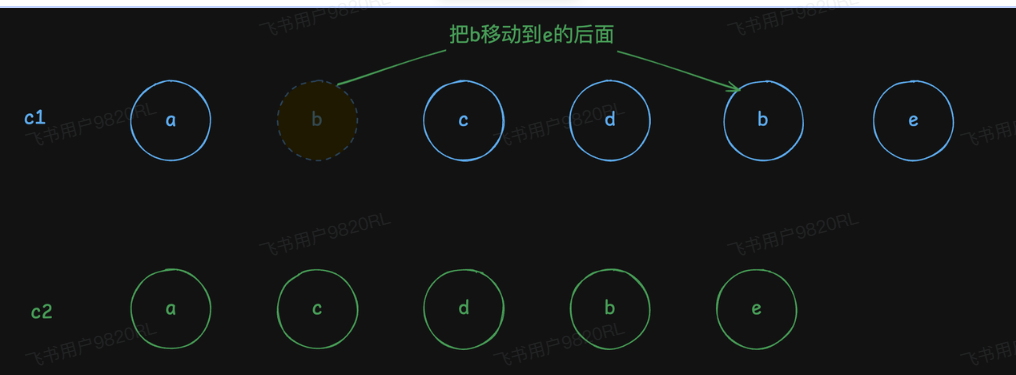 根据这张图可以看出,旧节点
[a, b, c, d, e]新节点[a, c, d, b, e],其实只需要将b移动到e前面,顺序自然就修正了,c和d之间并不需要移动,这样就可以节约一部分性能。这就涉及到最长递增子序列了。
顾名思义它是在一个序列中找到最长的连续递增子序列。
- [1,5,3,4,7,8]
- [10,3,5,9,12,8,15,18]
一眼就可以看出第一组序列汇总最长的递增子序列是[1,3,4,7,8]
先看[1,5,3,4,7,8]怎么算,掌握一下概念
1:LIS = [1](空列表直接加入1)5:LIS = [1, 5](5大于1,直接追加)3:LIS = [1, 3](3小于5,用3替换5)4:LIS = [1, 3, 4](4大于3,追加)7:LIS = [1, 3, 4, 7](7大于4,追加)8:LIS = [1, 3, 4, 7, 8](8大于7,追加)
由此算出最长递增子序列为[1, 3, 4, 7, 8]
第二组[10, 3, 5, 9, 12, 8, 15, 18]
10:LIS = [10](空列表直接加入10)3:LIS = [3](3小于10,用3替换)5:LIS = [3, 5](5大于3,追加)9:LIS = [3, 5, 9](9大于5,追加)12:LIS = [3, 5, 9, 12](12大于9,追加)8:LIS = [3, 5, 8, 12](8小于9,用8替换9)15:LIS = [3, 5, 8, 12, 15](15大于12,追加)18:LIS = [3, 5, 8, 12, 15, 18](18大于15,追加)
由此算出最长递增子序列为[3, 5, 8, 12, 15, 18],但是8和12的顺序似乎出现了错误,vue3里面使用了反向追溯的方式,来修正这个最长递增子序列。看一下:
10:LIS = [10](空列表直接加入10,记录10的起前一个为null)3:LIS = [3](3小于10,用3替换10,记录3的前一个为null)5:LIS = [3, 5](5大于3,追加,记录5前一个为3)9:LIS = [3, 5, 9](9大于5,追加,记录9的前一个为5)12:LIS = [3, 5, 9, 12](12大于9,追加,记录12的前一个为9)8:LIS = [3, 5, 8, 12](8小于9,用8替换9,记录8的前一个为5)15:LIS = [3, 5, 8, 12, 15](15大于12,追加,记录15的前一个为12)18:LIS = [3, 5, 8, 12, 15, 18](18大于15,追加,记录18的前一个为15)
结束以后我们通过最后一个倒序追溯
- 起点:
18 - 18的前驱是→
15 - 15的前驱是→
12 - 12的前驱是→
9 - 9的前驱是→
5 - 5的前驱是→
3
所以最终正确的LIS = [3, 5, 9, 12, 15, 18]
求最长递增子序列的函数:
ts
function getSequence(arr) {
    const result = []
    // 记录前驱节点
    const map = new Map()

    for(let i = 0; i < arr.length; i++) {
        const item = arr[i]
        // -1不在计算范围内
        if(item === -1 || item === undefined) continue

        // 为了忽略第一项是-1 或者undefined
        if(result.length === 0) {
            // 如果result 里面一个都没有,把当前的索引放进去
            result.push(i)
            continue
        }

        const lastIndex = result[result.length - 1]
        const lastItem = arr[lastIndex]

        if (item > lastItem) {
            // 如果当前这一项大于上一个,那么就直接把索引放到 result 中
            result.push(i)
            // 记录前驱节点
            map.set(i, lastIndex)
            continue
        }

        // item 小于 lastItem,开始二分查找
        let left = 0
        let right = result.length - 1

        while (left < right) {
            const mid = Math.floor((left + right) / 2)
            // 拿到中间项
            const midItem = arr[result[mid]]
            if (midItem < item) {
                left = mid + 1
            } else {
                right = mid
            }
        }

        if (arr[result[left]] > item) {
            // 找到最合适的,把索引替换进去
            result[left] = i
            map.set(i, map.get(left))
        }
    }
    // 反向追溯
    let l = result.length
    let last = result[l - 1]
    while (l > 0) {
        l--
        // 纠正顺序
        result[l] = last
        // 去前驱节点里面找
        last = map.get(last)
    }
    return result
}注意,此处我们求的是索引值,因此我们会得到一个数组,数组中保存的索引是不用移动的,我们来修改一下代码
ts
const patchKeyedChildren = (c1, c2, container) => {
  /* 省略双端 diff */

  /**
   * 2. 乱序
   * c1 => [a, (b, c, d), e]
   * c2 => [a, (c, d, b), e]
   * 开始时:i = 0, e1 = 4, e2 = 4
   * 双端对比完结果:i = 1, e1 = 3, e2 = 3
   *
   * 找到 key 相同的 虚拟节点,让它们 patch 一下
   */

  // 老的子节点开始查找的位置 s1 - e1
  let s1 = i
  // 新的子节点开始查找的位置 s2 - e2
  let s2 = i

  /**
   * 做一份新的子节点的key和index之间的映射关系
   * map = {
   *   c:1,
   *   d:2,
   *   b:3
   * }
   */
  const keyToNewIndexMap = new Map()

  // 💡  保存一份索引,记录的子节点的索引在老的子节点中的位置
  const newIndexToOldIndexMap = new Array(e2 - s2 + 1)
  // 💡  -1 代表不需要计算的
  newIndexToOldIndexMap.fill(-1)

  /**
   * 遍历新的 s2 - e2 之间,这些是还没更新的,做一份 key => index map
   */
  for (let j = s2; j <= e2; j++) {
    const n2 = c2[j]
    keyToNewIndexMap.set(n2.key, j)
  }

  /**
   * 遍历老的子节点
   */
  for (let j = s1; j <= e1; j++) {
    const n1 = c1[j]
    // 看一下这个key在新的里面有没有
    const newIndex = keyToNewIndexMap.get(n1.key)
    if (newIndex != null) {
      // 💡  在这里赋值,记录位置
      newIndexToOldIndexMap[newIndex] = j
      // 如果有,就怕patch
      patch(n1, c2[newIndex], container)
    } else {
      // 如果没有,表示老的有,新的没有,需要卸载
      unmount(n1)
    }
  }
  // 💡 求出最长递增子序列
  const newIndexSequence = getSequence(newIndexToOldIndexMap)
  // 💡 换成 Set 性能好一点
  const sequenceSet = new Set(newIndexSequence)

  /**
   * 1. 遍历新的子元素,调整顺序,倒序插入
   * 2. 新的有,老的没有的,我们需要重新挂载
   */
  for (let j = e2; j >= s2; j--) {
    /**
     * 倒序插入
     */
    const n2 = c2[j]
    // 拿到它的下一个子元素
    const anchor = c2[j + 1]?.el || null
    if (n2.el) {
      // 如果 j 不在最长递增子序列中,表示需要移动
      if (!sequenceSet.has(j)) {
        // 💡 依次进行倒序插入,保证顺序的一致性
        hostInsert(n2.el, container, anchor)
      }
    } else {
      // 新的有,老的没有,重新挂载
      patch(null, n2, container, anchor)
    }
  }
}我们虽然求出了最长递增子序列,但是这
c1 = [a, b, c, d, e]c2 = [a, h, b, c, d, g, e]
在这种情况下,我们不需要求最长递增子序列,因为我们可以直接将 h 和 g 插入到 b 和 e 之间,这样就可以了,因为 b、c、d 之间的顺序是不会变的,它们本身就是递增的,所以我们根据这个案例可以得出一个结论,如果新的子节点在老的子节点中本身就是连续递增的,那么我们就不需要求最长递增子序列了,所以我们再来修改一下代码
ts
function patchKeyedChildren(n1, n2, container, anchor) {
    /**
     * 省略双端diff
     */

    /**
     * 省略部分乱序 diff
     */
    // 表示新的子节点在老的子节点中本身就是连续递增的
    let pos = -1
    // 是否需要移动
    let moved = false

    /**
     * 遍历老的子节点
     */
    for (let j = s1; j <= e1; j++) {
        const n1 = c1[j]
        // 看一下这个key在新的里面有没有
        const newIndex = keyToNewIndexMap.get(n1.key)
        if (newIndex != null) {
            if (newIndex > pos) {
                // 💡 如果每一次都是比上一次的大,表示就是连续递增的,不需要算
                pos = newIndex
            } else {
                // 💡 如果突然有一天比上一次的小了,表示需要移动了
                moved = true
            }
            newIndexToOldIndexMap[newIndex] = j
            // 如果有,就怕patch
            patch(n1, c2[newIndex], container)
        } else {
            // 如果没有,表示老的有,新的没有,需要卸载
            unmount(n1)
        }
    }
    // 💡 如果 moved 为 false,表示不需要移动,就别算了
    const newIndexSequence = moved ? getSequence(newIndexToOldIndexMap) : []
    // 换成 Set 性能好一点
    const sequenceSet = new Set(newIndexSequence)

    /**
     * 1. 遍历新的子元素,调整顺序,倒序插入
     * 2. 新的有,老的没有的,我们需要重新挂载
     */
    for (let j = e2; j >= s2; j--) {
        /**
         * 倒序插入
         */
        const n2 = c2[j]
        // 拿到它的下一个子元素
        const anchor = c2[j + 1]?.el || null
        if (n2.el) {
            if (moved) {
                // 💡 如果需要移动,再进去
                // 如果 j 不在最长递增子序列中,表示需要移动
                if (!sequenceSet.has(j)) {
                // 依次进行倒序插入,保证顺序的一致性
                hostInsert(n2.el, container, anchor)
                }
            }
        } else {
            // 新的有,老的没有,重新挂载
            patch(null, n2, container, anchor)
        }
    }
}四、文本节点
前面都是使用虚拟DOM创建某一个节点,渲染到页面中,其实vue还支持渲染文本节点,简单来说就是将一个文本节点渲染到真实DOM中:
ts
import { h, render, Text } from '../dist/vue.esm.js'
// 创建一个文本节点,内容为 'hello'
const vnode1 = h(Text, null, 'hello')
// 将 vnode1 渲染到 app 元素中
render(vnode1, app)这个功能并不需要修改虚拟createVNode中的代码。先创建这个Text标记:
- vnode.ts
ts
// vnode.ts
/**
 * 文本节点标记
 */
export const Text = Symbol('v-txt')vnode.ts 中就做这一件事,其他的我们交给 renderer.ts 来处理
ts
const patch = (n1, n2, container, anchor = null) => {
    if (n1 === n2) {
        // 如果两次传递了同一个虚拟节点,啥都不干
        return
    }

    if (n1 && !isSameVNodeType(n1, n2)) {
        // 比如说 n1 是 div ,n2 是 span,这俩就不一样,或者 n1 的 key 是1,n2 的 key 是 2,也不一样,都要卸载掉 n1
        // 如果两个节点不是同一个类型,那就卸载 n1 直接挂载 n2
        unmount(n1)
        n1 = null
    }

    /**
     * 文本,元素,组件
     */

    const { shapeFlag, type } = n2

    // 💡 由于我们后面会有其它类型的虚拟节点,比如 组件,元素等,所以我们改造一下之前的代码,写成 switch 语句
    switch (type) {
        case Text:
            // 💡 文本节点走这边
            processText(n1, n2, container, anchor)
            break
        default:
            if (shapeFlag & ShapeFlags.ELEMENT) {
                // 我们将原来处理元素的逻辑放到 processElement 里面去了
                // 处理 dom 元素 div span p h1
                processElement(n1, n2, container, anchor)
            }
    }
}在修改processText方法
ts
/**
 * 处理文本的挂载和更新
 */
const processText = (n1, n2, container, anchor) => {
    if (n1 === null) {
        // 挂载
        const el = hostCreateText(n2.children)
        // 给vnode绑定el
        n2.el = el
        // 把文本节点插入到container中
        hostInsert(el, container, anchor)
    } else {
        // 更新
        // 复用dom
        n2.el = n1.el
        if (n1.children != n2.children) {
            // 如果文本内容变了,就更新
            hostSetText(n2.el, n2.children)
        }
    }
}在processText中,我们判断n1是否为null,如果是null,表示是挂载,如果不是,表示是更新,通过hostCreateText创建一个文本节点,然后将它插入到容器中,最后将文本节点的el赋值给n2.el,这样就可以复用这个节点了。
完成这个功能后,在扩展一下功能,比如之前渲染虚拟节点的children,如果有有个直接点,只能传递虚拟进去:
ts
const vnode = h('div', [h('span', 'hello'), h('span', 'world')])只能写成这样的方式,如果有了文本几点,还可以写成这种方式:
ts
const vnode = h('div', ['hello', 'world'])写成这样,就不用每次都传虚拟节点进去了,但是这样做,在renderer内部挂载的时候,还是会把它转换成文本节点,因为字符串是不能挂载额,那就在挂载的时候把他转换一下:
ts
// vnode.ts
export function normalizeVNode(vnode) {
    if (isString(vnode) || isNumber(vnode)) {
        // 如果是string || number 转换成文本节点
        return createVNode(Text, null, String(vnode))
    }

    return vnode
}这个函数接受一个参数,如果接受的这个参数是字符串或者是数字,那么就将他转换为文本节点,最后返回一个虚拟节点,如果不是,就直接返回这个虚拟节点。
在挂载子节点的函数中,使用当前函数
ts
// renderer.ts
// 挂载子元素
const mountChildren = (children, el) => {
    for (let i = 0; i < children.length; i++) {
        // 进行标准化vnode
        const child = (children[i] = normalizeVNode(children[i]))
        // 递归挂载子节点
        patch(null, child, el)
    }
}所有挂载子节点的地方都需要这么做,否则将会在更新的时候发生错误:
ts
const patchKeyedChildren = (c1, c2, container) => {
    // 省略部分代码...
    while (i <= e1 && i <= e2) {
        const n1 = c1[i]
        // 💡 标准化 childr
        const n2 = (c2[i] = normalizeVNode(c2[i]))

        if (isSameVNodeType(n1, n2)) {
        // 如果 n1 和 n2 是同一个类型的子节点,那就可以更新,更新完了,对比下一个
        patch(n1, n2, container)
        } else {
        break
        }

        i++
    }
    while (i <= e1 && i <= e2) {
        const n1 = c1[e1]
        // 💡 标准化 childr
        const n2 = (c2[e2] = normalizeVNode(c2[e2]))

        if (isSameVNodeType(n1, n2)) {
        // 如果 n1 和 n2 是同一个类型的子节点,那就可以更新,更新完了之后,对比上一个
        patch(n1, n2, container)
        } else {
        break
        }

        // 更新尾指针
        e1--
        e2--
    }
    if (i > e1) {
        /**
         * 根据双端对比,得出结论:
         * i > e1 表示老的少,新的多,要挂载新的,挂载的范围是 i - e2
         */
        // 省略部分代码...
        while (i <= e2) {
            // 💡 标准化 childr
            patch(null, (c2[i] = normalizeVNode(c2[i])), container, anchor)
            i++
        }
    } else if (i > e2) {
        // 省略部分代码...
    }else {
        // 省略部分代码...

        /**
         * 做一份新的子节点的key和index之间的映射关系
         * map = {
         *   c:1,
         *   d:2,
         *   b:3
         * }
         */
        const keyToNewIndexMap = new Map()

        const newIndexToOldIndexMap = new Array(e2 - s2 + 1)
        // -1 代表不需要计算的
        newIndexToOldIndexMap.fill(-1)

        /**
         * 遍历新的 s2 - e2 之间,这些是还没更新的,做一份 key => index map
         */
        for (let j = s2; j <= e2; j++) {
            // 💡 标准化 childr
            const n2 = (c2[j] = normalizeVNode(c2[j]))
            keyToNewIndexMap.set(n2.key, j)
        }

        // 省略后续代码...
    }
}